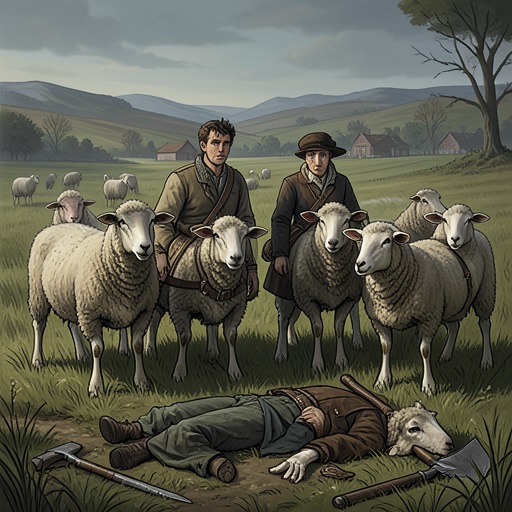
Maude
Three Bags FullMaude is the flock’s most accomplished smeller, and her nose is both a source of pride and a practical instrument in its investigation of George Glenn’s death. She reads people, danger, and the flock’s own distress through odors that humans barely register. Yet her exceptional sense does not make her all-knowing: the concealed hunter in the meadow evades her at first, and her scenes repeatedly show how uncertain judgment becomes when evidence must be interpreted across different kinds of bodies.
Identity and Sensory Knowledge
Maude’s defining trait is established plainly: she has a very good sense of smell and is proud of it. At the opening of the investigation, she remembers that George was healthy the day before. Her ears twitch nervously as she says so, while Sir Ritchfield counters that a spade is not an illness. Her observation cannot explain the death, but it establishes the difference between noticing a change and knowing its cause—a distinction that will govern the flock’s detective work.
Maude also understands that human beings do not smell as sheep do. When Rameses imagines that the murderer poured whiskey over bloodstained hands, she corrects the premise: people cannot really scent blood the way sheep can, and cannot smell much at all. Miss Maple agrees that they do not know whether the murderer’s hands were bloody or what happened. Maude’s expertise therefore has a double edge. It gives the flock access to evidence unavailable to people, while making human motives and perceptions difficult to reconstruct.
Her nose is not merely a tool for following a trail; it is how she reads the condition of other bodies. At a picnic, she finds Beth’s odor unpleasant and associates it with prolonged starvation and an early death. The scent interrupts Maude’s pleasure in the food aromas rising from the tablecloth. When the red-haired woman reaches for tomato salad, the sheep collectively sigh because they had hoped she would leave it uneaten. Maude’s attention moves between appetite and Beth’s distressing smell, placing ordinary flock concerns beside a human condition she can detect but cannot resolve.
The Hunter and the Contagion of Fear
During a night-time intrusion at the dolmen, Maude detects a human scent from above, though she cannot smell the masked men near the hay barn. Night scents have covered the intruders’ nervous perspiration; what reaches her instead is a faint odor associated with cooked food, seeping down from the capstone. She looks up and identifies someone lying there. Smoke and recently eaten onions sharpen the impression of a human presence, while the hunter’s position and scent awaken a memory of rocky ravines and lurking robbers. Maude thinks of a wolf.
Her response overturns the expected pattern of alarm. A sheep that thinks wolf should bleat and run, but Maude stays still because the enemy is close and seems to surround her. She keeps breathing in the scent, unable to flee. The other sheep learn of the danger without a call: Maude’s quick breathing and the salty, bitter change in her scent communicate fear, and the flock’s hearts race as they remain motionless with her. Because she is their warning sheep, they follow her lead. The scene makes her sense of smell a form of leadership, but also shows fear spreading through bodily signals before anyone can explain what is happening.
Later, when Miss Maple asks whether the hunter might return, Maude’s answer is practical: the important thing is that he does not come back, and if he does she expects to recognize his scent. Her confidence restores her pride, though the investigation has already shown that scent can be concealed. Maple eventually identifies Gabriel as the master hunter partly because Maude could not pick up his scent at first. Gabriel can disguise it beneath damp wool and smoke. Maude’s failure is consequential evidence: the nose remains powerful, but an experienced adversary can manipulate the very medium on which her authority depends.
Reading the Flock and Choosing a Future
Maude’s sensitivity extends to changes within the flock. When Ritchfield speaks in a way that sounds unlike himself, she describes his smell as sick, but not simply sick or sheep-like. She detects qualities resembling a one-horned young ram, an experienced mother ewe, a thick-fleeced young sheep that has not seen winter, and a very old ram near his last winter. She cannot make these impressions cohere and concludes that he somehow smells half. Mopple interprets the change as Ritchfield running out: the hole in his memory has grown so large that memories are escaping. Maude registers the bodily evidence before she can explain what it means.
She also resists resignation when Gabriel and the butcher discuss the flock’s prospects. As the sheep lower their heads, accepting what appears to be their fate, Maude continues to stare at the two men and urges the flock to try anyway. The moment gives her attentiveness a stubborn, collective purpose: she does not simply identify danger but keeps watch when the others have begun to submit to it.
That persistence appears again when George’s will is read. His fortune is to be used to send the sheep to Europe, and an authorized representative must accompany them as shepherd. The representative’s duties include having stories read aloud to the sheep for at least half an hour each day; the will also forbids selling or slaughtering them and makes dense fleece a breeding priority. After Rebecca volunteers and Othello leads the flock toward her, Maude calls Rebecca’s name. Her response helps make the sheep’s preference visible in a human legal process that otherwise treats their future as something an appointed representative will manage.
From Scent to Evidence
When the flock considers what might have killed George, Maude proposes mouse weed after Cloud identifies the spade. The surviving exchange does not establish why she proposes it, but it shows her contributing a possibility rather than leaving the investigation to Maple alone. Her role becomes more concrete in the later preparation of the flock’s reenactment of George’s death.
The sheep debate how they can depict the murderer when they understand human scent differently. Mopple argues that humans must detect some odor because they have noses; Maude helps test that idea against material evidence. In the toolshed she finds a faint, sourish smell on a rag that resembles Beth’s. To strengthen the scent, the sheep bury the rag overnight, cover it with chewed sorrel the next day, and wrap it around a recently dead shrew found by Heather. Sir Ritchfield takes on the task of chewing the sorrel. The result does not smell exactly like Beth, but the flock judges the similarity close enough to identify her.
The scent becomes part of a carefully staged scene. The rag supplies the supposed murderer’s odor, while a chain with a glittery pendant serves as the Thing resembling Beth’s. Because the chain and cross disappear into Maple’s fleece when hung around her neck, Maple carries the little cross in her teeth, with Mopple following close behind with the pungent rag. Maude’s work thus passes from private perception into a public attempt at proof. The performance depends on material details—scent, cloth, a shrew, sorrel, and a pendant—to make the flock’s understanding legible to an audience.
Narrative Role
Maude’s importance lies in the way she makes scent a form of knowledge without turning it into certainty. She can recognize danger through smoke and onions, register Beth’s physical decline, detect the strange change in Ritchfield, and help construct an identifying odor for the reenactment. But the disguised hunter demonstrates that a scent can be hidden, while the limits of human smell leave the flock unsure whether its evidence will convince anyone else.
Her pride, caution, and persistence bind the investigation’s practical and emotional dimensions. She warns the flock, shares its appetites, senses its fear, and refuses to give up when the sheep face slaughter. In the final performance, her nose helps translate a sheep’s way of knowing into a form humans might recognize. The translation is imperfect, but it is the flock’s own effort to make its evidence count.